

Craig Hurd-McKenney and I go way back, far enough that our connection to comics probably isn’t the most interesting part of the story. But I’ve had the pleasure of watching him create stories and comics from the beginning, and I’ve talked with Craig about his comics work for Smash Pages a couple of times over the years, most recently in 2025.
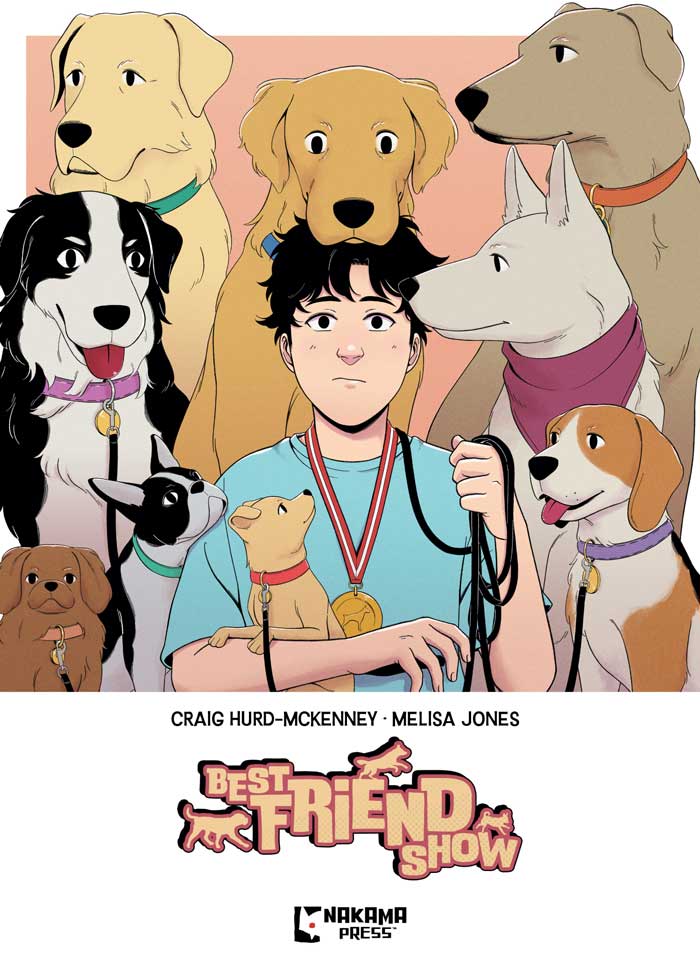
Now he’s taking on something a little different with Best Friend Show, a Young Adult graphic novel coming Mad Cave Studios’ Nakama Press imprint on Oct. 13. After a family illness and a breakup, the main character, Landon, spends the summer with his aunt at her dog rescue. There, he discovers an unexpected talent for working with dogs and finds himself drawn into the world of competitive youth dog shows.
Illustrated by Melisa Jones with colors by Jok, Best Friend Show is a story about dogs and competition on the surface, but Craig says his fascination with youth dog shows came from something deeper: the confidence and agency they can give young people. As Landon finds his way back into the world, his relationships with the dogs and the group of young handlers he meets become an important part of that journey.
I spoke with Craig about the real-life inspiration behind Best Friend Show, what he learned about youth dog shows, working with artist Melisa Jones and his longtime collaborator Jok, and the challenge of writing his first YA graphic novel.
What was the initial spark for Best Friend Show? Was there a particular character, image or idea that made you want to build a graphic novel around competitive dog shows?
As you already know, your dad was our family veterinarian for many, many years. So dogs have always been a part of my life, having grown up with dogs (a dachshund, a cocker spaniel and a chihuahua). The bond between an owner and their dog is extremely unique. I’d worked at rescues as a young person, so all of the nuts and bolts were already there for my emotional connection to the story. But it wasn’t until I found out about youth dog shows that I became obsessed. The entire model is meant to boost the confidence of young people, and I just thought that was an incredibly special environment in which to set a story.
What drew you to the world of competitive dog shows, and what did you discover while researching it that surprised you?
I like the idea of a young person, governed by “the norms” of their school or friend group culture, really putting themselves out there in a way that risks embarrassment, labeling, and the like. Because at the end of the day, life is to be lived. And so, these young people are doing quite extraordinary things when they are competing. And they do it unapologetically. I was a bit that way as a young person, and I have conversations now about how friends from the time or even my brother perceived me. I’m always shocked to hear that I was seen as innovative and unbothered when I always felt like I was being a lonely weirdo. We need more young people exhibiting agency. And that brings us to Best Friend Show.
Two things I learned during this process which surprised me: unlike the dog show you see on TV at Thanksgiving, what is being evaluated in a youth show is the relationship between the handler and the dog. How connected has this kid become with the dog, and how do they relate? That is incredible to me … that the bond is what’s important. The other thing I learned is that the judges can ask questions, kind of challenging the kids’ knowledge of the breed of their dogs.
Landon discovers that he has a talent for training dogs. Did you see that primarily as a skill he develops, or as a way for him to learn something about himself and how he connects with other people?
One of the early script notes I got was that Landon wasn’t likable. And I knew I’d done him a terrible disservice because in my mind he is empathetic and thoughtful; he brings this little tribe together. So I went back and used the relationship with the dogs to fully illustrate this character trait. It’s not so much a skill he develops, but moreso that the environment at the dog rescue provides him the place for this deep empathy to flourish. And then we get into what he is learning about himself, and how he connects with other people, as a result.
And of course, let’s talk about the dog. Blue is both a beloved friend and a champion show dog. How did you approach that relationship, particularly the tension between Landon’s emotional bond with Blue and the competitive demands of the show world?
Blue is one of several dogs in the book, and I love them all. Melisa (our artist) has given such vigor to every one of them. But Blue is the dog that Landon works with because Blue was his Aunt Iva’s show dog. Aunt Iva knows that if she pairs the two together that it will help Landon. Landon does not want to get out of bed when the book starts due to two major life moments that happen. Dogs have no sense of this, so Blue is forcing Landon to get out of his own head and out of bed. Blue just intrinsically knows what his role is. And I love this about dogs … their innate ability to heal us. To that, Landon is aware enough to be thankful for Blue reminding him that life does have to keep moving on, whether we are ready or not.
The book deals with some pretty serious themes, like illness, heartbreak, healing and second chances. But the dog-show setting also gives you plenty of opportunities for humor and fun. How did you find the balance between those two sides of the story?
Landon meets a group of fellow youth handlers during the course of the book. They were not originally part of my plan for the book, but they really serve to break up the heavy parts of the story. They’re kids across an age range, and it’s summer vacation for them. So they get to laugh and be kids and play. They are a source of a lot of the humor in the book, and another reminder for Landon that life has to go on. Melisa gave them very unique looks, even thinking about the kinds of clothing they would wear — from texture to fabric. They really come alive as a result!
There’s a lot of visual potential in a story about dogs, dog shows and a Best in Show competition. Were there particular sequences or moments that you especially enjoyed seeing come to life on the page?
I have worked with Melisa on a couple of projects, so I’m always thrilled to see her pages come in. Although she probably will never work with me again after giving her stadiums full of people, sitting in bleachers and awaiting the dog shows lol.
But in all seriousness, Melisa brings such thoughtfulness to the character designs, and warmth/humanity to the characters. They are all so expressive, human and canine alike. I can’t wait for everyone to see what a talent Melisa is.
You’ve worked with Jok on a number of projects over the years. What was it like bringing them onto this one, and did having that established creative relationship change the way you worked together? And what did Melisa bring to the book that you hadn’t necessarily envisioned when you were writing it?
Jok is the hardest working person in comics. I love working with him because their drive to produce work is even higher than mine. I find they just make me want to create even better things for them. So I rely on him a lot. We hit a little scheduling snag (this is comics, it happens!), so I had to reach out to the guys to help get us through that. Jok came in to do all of the grey tones on the book, to keep it from looking extremely flat. And Gervasio helped us out on some of the backgrounds. There’s no real difference between working with them and with Melisa, as I’d worked with both of them before. I write to their strengths and interests. What I will say is that Melisa is a huge part of why the friend group became so prominent. Once I saw the designs, I wrote more for them to do. All that said, I’m so grateful to work with such talented people. I know I asked a lot, and they delivered!
You and I have known each other for a long time, as you mentioned, and we’ve talked before about your previous projects. Was there anything about making Best Friend Show that felt particularly different from the kinds of stories you’ve tackled before? And what do you hope readers take away from Landon’s summer?
Most of my books are in the horror genre, and all of them are LGBTQIA2S+ friendly. But I found I was terrified of writing a YA book. It was extremely challenging for me at first, but it was all mental. I was giving myself mental blocks which were making it quite arduous to script. I finally had to give myself a stern talking-to and remember that this is just a story … don’t write down to younger people, don’t write up to older people. Just tell the best story you can. And I think we did that.
I’m also now decidedly less nervous because it was an awesome challenge, and it is important to show some versatility in one’s portfolio, as it were.
One thought on “Smash Pages Q&A | Craig Hurd-McKenney on ‘Best Friend Show’”