
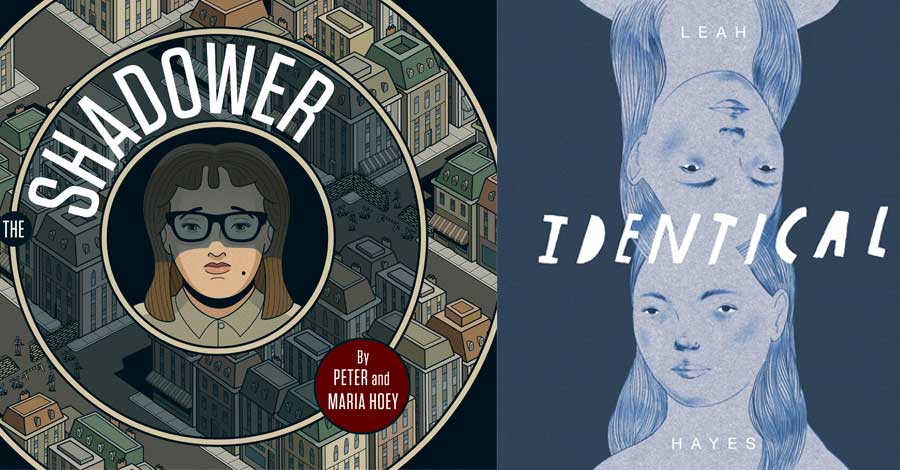
For artists Maria Hoey and Leah Hayes, identity is both a subject to explore and something that keeps evolving. In the latest Picture + Panel conversation from the Boston Comics Arts Foundation, the two creators will discuss how their experiences shape their work, why identity can be fluid rather than fixed, and the freedom that comes with refusing to be just one thing.
The two creators will meet in person on Nov. 2 from 7 p.m. to 8 p.m. at the Boston Figurative Arts Center, 285 Washington St, Somerville, MA 02143.
Hoey, who collaborates with her brother on graphic novels, explores identity through surrealism and transformation. In The Shadower, a spy thriller set in a country emerging from a brutal civil war, protagonist Nadia must impersonate another woman to carry out a mission, blurring the boundaries between the self and the person she must become.
Hayes approaches identity through her work across comics, music and illustration, as well as her experience as an identical twin. She sees creativity as a process of reconnecting with yourself while trying new things — less a matter of reinventing yourself completely than allowing yourself to grow.
In the conversation below, Hoey and Hayes reflect on the artists and films that have influenced them, the labels they resist, and why identity doesn’t have to be a fixed destination.

How did you get interested in the topics if self and identity?
Maria Hoey: As an artist, I think we are all prone to self-contemplation and obsession.
Leah Hayes: It’s funny … being an artist my whole life, you’re sort of always delving into the idea of “self” and “identity” anyway. But being an identical twin makes that so much more … interesting, I think. It’s sort of an exhausting job as an artist (or as a human in general) always trying to understand yourself, but when you have someone else acting as a reflection of self, a reflection of your ideas and fears and hopes, it’s a delightfully less lonely pursuit.
Why did you start making comics about identity?
Leah Hayes: I wouldn’t say that I started writing comics about identity. As I mentioned above, it’s just something that nearly every artist is already ruminating on. But I have always grappled with my “identity” as a twin, as a musician, as an illustrator, and as a writer. I can do more than one thing, and I always want to be doing more than one thing at a time, and sometimes that is confusing for constructing one’s “identity,” whether that means in the public eye or even in your own inner eye.
Maria Hoey: The Shadower is a spy thriller set in a country emerging from a brutal civil war, and the idea of identity is integral to the plot. Nadia is tasked to impersonate another woman in order to spy for her faction — she must literally lose herself in order to do this.
Identity — both the individual’s physical presentation and also the state of being — is a fascinating way to have our character Nadia navigate and survive a harrowing mission. Nadia is on her own and has no choice. Whether she survives is up to her.
How is identity integrated into your work?
Maria Hoey: With a lot of my graphic novels with my brother, we use the supernatural or surrealism to play with the idea of reality. This surrealism allows us to build a world in which the self is truly physically and chemically fluid.
In The Shadower, we tell a big story — a harrowing story — in a dangerous city in a time of political unrest, and we experience it (literally) through the eyes of our reluctant hero, Nadia. It’s a timely story, too: the idea of how an individual holds up under the pressure of living in dark times. Do you lose yourself? Or do you persevere?
Leah Hayes: I would say that with each book that I write, or each song that I put out … I am trying to reconnect with myself, while also attempting something new. Every time we go inside ourselves and yank out something to put on paper (or on record), there’s a mashup of consistent styles, with some new “experiments” thrown in.
That’s the fun of being creative, I think: not reinventing yourself every time, but rather playing with your old self enough that it becomes slightly different. I kind of raise my eyebrows at artists who say that they “totally reinvent themselves” every time they make a new record or book. I don’t think that’s possible. It’s more like growing.

What’s your favorite thing about identity?
Leah Hayes: About myself? Well, I think when we identify with something, it means: What is the fundamental thing that we are sure about in ourselves?
For me, that is #1 being able to draw. I often say that if there is one thing that I am most sure of in the world, it is that I can draw most things pretty well. Like, if my house was burning and my kids were trapped inside and the only way I could save my whole family was to draw whatever someone put in front of me, I’m pretty positive that they would come out alive.
And #2: being a twin. Not in that order, either … I think my being a twin has preceded my identity as an artist.
Maria Hoey: Identity informs everything we do — whether consciously or unconsciously — and this allows us as individuals to make (and hold) singular and unique stories, art and ideas. It’s what makes us human.
What’s your least favorite identity?
Maria Hoey: Well … living in the United States in 2026, I can think of one.
Leah Hayes: My least favorite identity is probably when people insist on calling me a “female graphic novelist.” That used to happen a lot in the early days. It was an indication of how few women were making graphic novels, really. People don’t say that as much anymore, but it did bug me. I was always like: “Just call me a graphic novelist!”
What misconceptions have you found people have about identity?
Leah Hayes: This is an interesting question. Identity is something that people HAVE, but are also always searching for (again — especially artists and creative people).
I think that people feel like you have to be born with your identity in place (not true), and also that if you find an identity later on that “fits” you, you have to stick with it for your whole life. I don’t find this to be true.
I have lots of students who ask me how they will find their style (drawing, painting, etc.). They want a style that identifies them. This is fine! But when they lock into that, I think it’s important to know that this can change, shift, morph, grow. This applies to artists and non-artists, by the way.
I like to think of life as “chapters,” where you can discover and try out new and different things … and that experimentation CAN BE part of your identity, too. You don’t just have to be one thing.
Maria Hoey: That identity is not just a fixed list of attributes (in a generically assigned-by-society way). Identity is, in fact, the self. Also, that we are bound by very little. We can always change — or, in the case of our character Nadia, transform.
Are there other media about identity that have inspired your work?
Maria Hoey: I really love Abbas Kiarostami’s films. His movie Close-Up is delightfully all about identity and what is real and not.
Also, Cristian Mungiu’s film 4 Months, 3 Weeks, and 2 Days — a 2007 film made in Romania. It follows two young women on a nightmarish odyssey. It is visually so arresting, and the story was one I kept thinking about while working on The Shadower.
Leah Hayes: Okay, so … for me, one of the most important graphic novels about finding your identity is Persepolis by Marjane Satrapi, and Geneviève Castrée’s Susceptible. Both of these women broke barriers in terms of identity by crossing multiple creative fields and blasting out works that confused and surprised people who tried to put them in only one category.
Also, Shel Silverstein. Did you know he wrote some of the biggest hit songs of the ’70s and ’80s? What a badass. Oooh, and Carol King. And Peter J. Brant. And Carson Ellis … these are examples of people who tried or try many things and are good at all of them!
If you could recommend one other graphic novel about identity to people who love your work, what would it be, and why?
Maria Hoey: I would recommend what I (re)read this week — and I think they go well together — FKT by Ed and Andre Krayewski and Safe in Hell by DV Nikt. Each seems so completely and wonderfully informed by the identity of the creators. They are unique and genius, and you can feel the shades of the artists’ identity (their individuality, their obsessions, their influences) in each.