

Paul “Zeronis” Kwon has spent much of his career creating characters for some of the biggest games in the world, including League of Legends, where he helped design fan-favorite champions such as Ahri, Vi and Gwen. He also worked on the Star Guardian universe and K/DA, bringing familiar characters into different visual worlds.
But Zeronis’ path to the video game industry began much earlier, with Final Fantasy VII and a young artist trying to make friends after moving from Korea to the United States. Unable to speak English, he drew Cloud Strife from memory and gave the drawings to his classmates.
That early connection between games and art eventually became a career, but Zeronis says his artistic identity is still evolving. His new book, Reminiscent: Art of Zeronis, collects 152 pages of professional work, fan art and, most importantly, personal pieces that show the experimentation happening outside the constraints of game development. The deluxe hardcover is currently being crowdfunded through Kickstarter by Clover Press.
I spoke with Zeronis about finding his artistic voice, the difference between designing characters for games and for himself, the lessons he learned creating League of Legends champions and skins, and the games and anime that continue to inspire him.
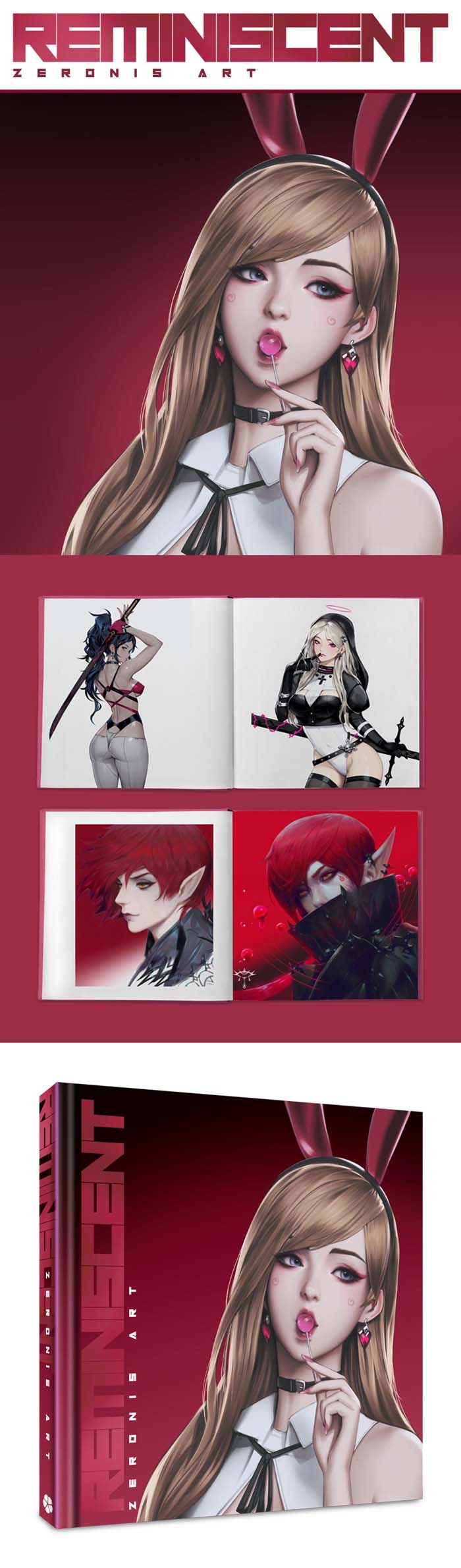
Your work has a very distinctive blend of stylized, anime/manga-influenced character design and more detailed rendering. How did that visual language develop over the course of your career?
I guess it is all about what I was interested in growing up. When I began drawing, it came from playing video games. I was introduced to games like Final Fantasy VII. That was the first one I actually got to play, and was allowed to play, as a young kid. I was deeply immersed in that world and could not stop playing.
At the time I migrated from Korea to the United States. I did not speak any English, so the only way I could communicate and make friends was drawing Cloud Strife from memory and giving a drawing of him to my classmates. That is how I made friends and got, I guess, popular enough.
Afterwards I would get into different types of art styles, playing games, watching anime, and just implementing those styles into my work. Especially nowadays I am looking at social media, X and Instagram, and following different artists with a variety of styles. I am constantly intrigued by those artworks. I guess that is how my art evolves and does not stick with one style.
I have been subconsciously thinking that might be a negative thing, because I do want to find an identity I can rely on, a personal style I can own and consistently create artwork in, so it becomes branded as my own. This art book, Reminiscent, will really showcase the indecision I have with my personal work and personal style. I think that has to do with me being very intrigued and wanting to try different styles of artwork
Reminiscent brings together many of your personal pieces. Why was it important to you to include that broader range of work rather than simply presenting your biggest professional hits?
To be honest, it is simply because the professional and fan artwork is hard to include because of the fees I would have to pay. There are licensing fees that can be very costly. That is why most of the work you will see in the book will be personal pieces. Hopefully people are pretty excited to see those.
I would say my professional and fan artworks are more popular, and I am much more well known for those. So I am taking a risk by just showcasing my personal stuff. I do hope people will be interested and excited to see some old personal works and some new ones as well.
At the same time I do want to brand myself and make myself known for creating original characters and original illustrations or pin-up art. I want to continue to grow my brand as an artist.

How does designing a character for a game differ from designing a character simply to be looked at? What kinds of compromises or considerations come into play when the artwork ultimately has to function inside a game?
For games, there are a lot of constraints and parameters to follow. Technical stuff, scope. There are a variety of things to consider, and it also involves different disciplines of game developers working alongside you. So it is a lot of collaborative effort. It is not something you can just come out with and roll with. You have to respect and honor a lot of the decision making required to make a very good character that will work inside that game, with specific game mechanics, brand, and art direction.
For personal work, I can pretty much do whatever I want, without having to worry about how to implement and build it into the game, how it is going to be translated to 3D without clipping issues, or whether it has to look authentic to the character lore, the world building, or the gameplay mechanic. Personal work is usually just a one-off. A lot of my characters, illustrations, and pin-up art are just one-offs, which is very freeing. It is a nice contrast to what I actually do in my day to day full time job, which is figuring out problems, how to solve them, and how to make the character work with all those parameters and rules.
What are some of your influences in games, manga/anime or other media, that you draw from or even just enjoy for their own sake?
I started out being introduced to the Final Fantasy series, VII, VIII, and IX, and also Zelda: Ocarina of Time. I got super immersed in those games. I played all night, even saw the sunrise, and panicked that I had to go to school in a few hours. I just kept drawing characters from them, even Zelda, like Link, and memorized how to draw him.
After that I got very much into StarCraft, StarCraft: Brood War, and Diablo II. Those games were much more mature rated. I was very immersed in those worlds, but I was also very scared. It really scared me. But I absolutely loved them. It is hard to find games nowadays that give that kind of immersive experience, because I guess I am more of an adult now and my mind is a little different. I would say Breath of the Wild really gave that similar level of immersion recently. Breath of the Wild and Tears of the Kingdom are probably some of the best games ever made.
Other than that, I played a lot of single player games. Naughty Dog games like Uncharted and The Last of Us were some of my favorites. Shadow of the Colossus was my absolute favorite. Resident Evil 4 I played on every single console it came out on, and I think I unlocked everything in that game. There are many games. Baldur’s Gate 3 is my recent favorite.
For anime, I watched Evangelion. That is very memorable, something that really hits me and inspires me very strongly. Attack on Titan season 1 I binged. Otherwise I do not really watch much anime. I just really appreciate the artwork of anime. The Persona series has really good artwork. Metal Gear Solid was definitely one of the console games I was very obsessed with. Too many to list. I probably left a lot out, but that is what I have.

You’ve designed some of the most recognizable characters and versions of characters in League of Legends. What makes a character design stick with an audience? Is there a particular moment when you know you’ve created something that players are going to connect with?
Some of the characters are very straightforward, like Ahri. When I designed her, I was just a student who was broke, wanted a job, and took on this contract work from Riot Games. I did not play League of Legends.
One day they told me, this is super urgent, just do a sketch of it. It was pretty straightforward. They wanted a nine-tailed fox girl who looked beautiful and seductive, I guess. It was right up my alley. So I designed her, did one sketch, sent it to them, and never heard back. Later on, a couple of months later, when I accepted the job, they told me she made it into the game, and she is one of the most popular characters to this day.
Some other characters are a bit more tricky. I do remember some characters that never made it into the game because I think the team overthought the problem and could not really feel the potential of the character. The idea and the role of the character all became muddy because there were too many back and forths, conflicts, and overthinking. That tends to happen.
When it is really easy, like Vi, it is a punk, tomboyish girl with an attitude. A cool, tough character with big gauntlets, a robotic arm, and robotic fists that punch you. That is very straightforward, so it was easy to design it and get it approved.
Same with Gwen. We knew the goal was to make a character similar to Lux, a youthful female character that could be relatable to the audience. So we made a young female character who was excited about giant spectral scissors. It was very clear, those two ideas. That is how you make characters. It does not have to be overthought or overcomplicated. The idea has to be very clear, exciting, and something you know is going to resonate with the audience really well.

Star Guardian and K/DA both take League of Legends characters and put them into dramatically different visual worlds. How different is the process of creating an entirely new character from reimagining an established character in a new setting? What did those projects teach you about adapting an existing character while still making them feel recognizable?
Early on it was not too different. I think I made about eight to nine champions in the span of a couple of months. Almost every week or two I was designing a champion, and every time I was done I would go up to the board and pick out the idea I was interested in, like the spider queen, or plant lady, or lion man.
As the roster of characters expanded past 150 or something in the game, it became more complicated, because a lot of gameplay started to overlap and it had to be done in a more delicate sense. Introducing a new champion to the game and to the world required careful plotting narratively. But mainly it had to do with gameplay, and also making sure the character did not feel too similar to an existing character. It is definitely tricky to make a brand new character, and it does take a little more time.
For skins, it is all about dressing them up. The goal is to make something that would get players and fans of those characters excited to buy those skins. It is about choosing the right thematic for the right characters, and making sure you do not change too many things that would compromise the readability and authenticity of that character. A lot of silhouettes, and even subtle nuance elements that are very important to the character, could not be changed too much. Those are the differences.