

Clover Press’s first volume of The Amazing Spider-Man: Classic Newspaper Comics is an engaging artifact of a pivotal period in the character’s history. Produced by the foundational Spidey team of writer Stan Lee and penciller John Romita, the strip debuted almost 50 years ago, on January 3, 1977. Volume one, which covers that calendar year, presents a series of arcs that certainly feel like Spider-Man, just with the format and rhythms of daily installments.
Of course, by the time this strip started, Lee and Romita had both moved on from the Amazing Spider-Man comic book. During 1977, writer Len Wein and penciller Ross Andru headed up ASM (issues #166-178), while penciller Sal Buscema and an assortment of writers were getting its companion title, Peter Parker, The Spectacular Spider-Man, off the ground (issues #4-16).
In hindsight, 1977 was part of a transitional period for the character. Following Gwen Stacy’s death four years earlier, Peter had started seeing Mary Jane Watson regularly, while Spidey faced off in ASM against C- and D-listers like Stegron, Will O’ The Wisp, Rocket Racer, the Molten Man, and a non-Osborn Green Goblin. Things were a little more original over in PPTSSM, which guest-starred the White Tiger and introduced Razorback. Maybe the biggest news was on CBS, where the first Amazing Spider-Man TV movie premiered on September 14.
Against that backdrop, the ASM strip presented perhaps the most accessible version of Spidey and company. It would have been familiar to current comics readers (presenting a Peter who’d been Spider-Man for some time, and was involved with Mary Jane), but clearly it couldn’t be part of the same continuity.
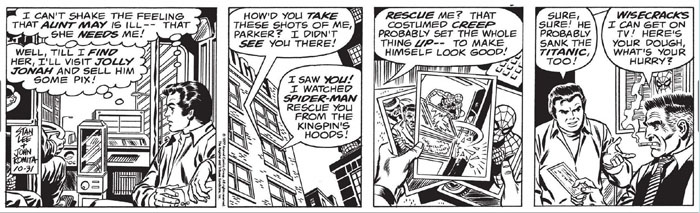
So, with all that for context, how was it? As a newspaper adventure strip, pretty good! Each arc (mostly villain-centered) lasted about two or three months, and was centered around some complication preventing Spider-Man from just punching the bad guy. When Doctor Doom came to the United Nations in the first arc, diplomatic immunity got in the way. Following that, Doctor Octopus used his preexisting relationship with Aunt May to try and steal a priceless artifact. New villain the Rattler wanted to go after Peter Parker, while the Kingpin sought to recruit Spidey as part of his mayoral campaign. Finally (after a four-week interlude flashing back to Spidey’s origin), Jonah Jameson hired Kraven to take out Spider-Man once and for all.
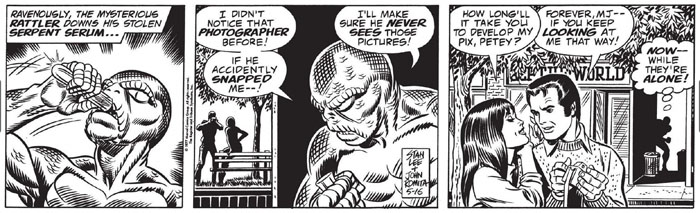
Obviously, there was no shortage of action. In fact, considering that the ASM comic was built on a mixture of heroics and soap opera, the former tended to dominate. This might have helped distinguish it from the likes of Mary Worth or Apartment 3-G, or it might just have been marketing. After all, why would someone want to read a Spider-Man strip if Spidey wasn’t front and center most days?
Naturally, any collection of newspaper strips basically speeds up that day-to-day plot cadence. Adventure strips can be especially susceptible to a certain hyperactivity in collected form, since each daily installment implicitly has to encourage the reader to come back for more. When a handful of strips are laid out on a single page, and each one conforms to the same basic pattern of panels, the effect can be a little frenetic.
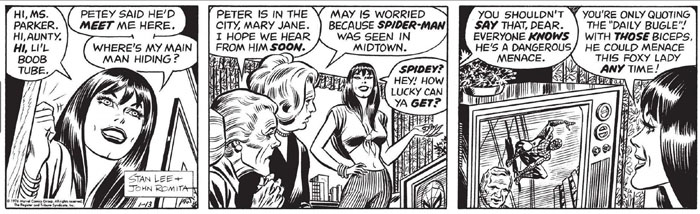
Fortunately, Lee and Romita never let the pacing slip into overdrive. There’s a solid “button” in each strip’s final panel, whether it’s an action moment or a character beat. It may be a lesser-known part of Stan Lee’s career, but he did have a decent amount of experience writing newspaper comics in the 1950s and 1960s, and this gig probably allowed him to access that old muscle memory.
Somewhat surprisingly (at least to me), John Romita doesn’t seem to have worked on any comic strips before this, probably because he was in demand from the Big Two comic-book publishers. However, his work adapts easily to this format without losing any of its dynamism. Panels never feel cluttered, and expand often to accommodate action. It’s not clear to me if anyone else inked Romita’s work, or who colored the Sunday strips; otherwise, I would have credited them. The lettering appears to be from Bullpen stalwarts including Irv Watanabe.
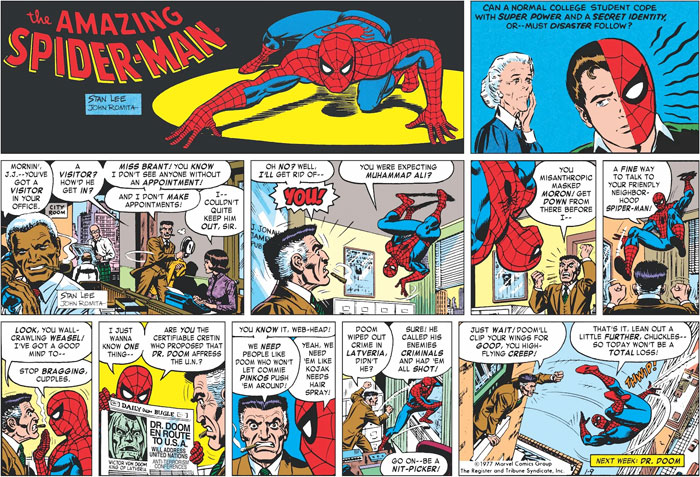
To be sure, the ASM strip isn’t much more than new installments of Lee/Romita Spidey in a different format. There’s nothing really revolutionary about the stories or their execution, no simmering subplots like the mystery of the Green Goblin, and no shock endings or gut-wrenching pathos. It’s a few panels a day (more on Sundays) times 365. That said, though, it’s Stan Lee and John Romita, not too far removed from the work that defined Spidey for generations.
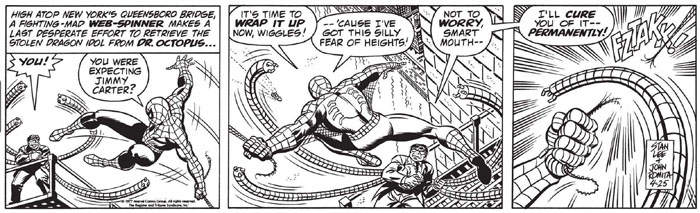
Accordingly, it was pretty fun to read a year in the life of Newspaper Spidey. Romita would stay with the strip for four years – coincidentally, the period which Clover’s first set of ASM reprints covers – and I’m looking forward to what comes next.
One thought on “Review | Clover Press delivers a swingin’ look at Spider-Man’s newspaper adventures”