
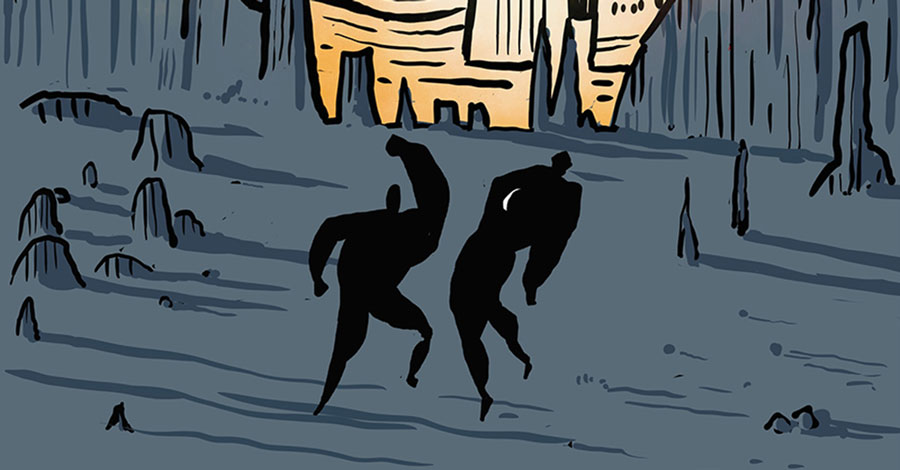
After years of turning his sharp eye for politics, history, science and biography toward nonfiction in graphic novels like Supercrash, Billionaires: The Lives of the Rich and Powerful, Putin: The Rise of a Dictator and Elon Musk: American Oligarch, Darryl Cunningham decided to go a different route with his newest graphic novel.
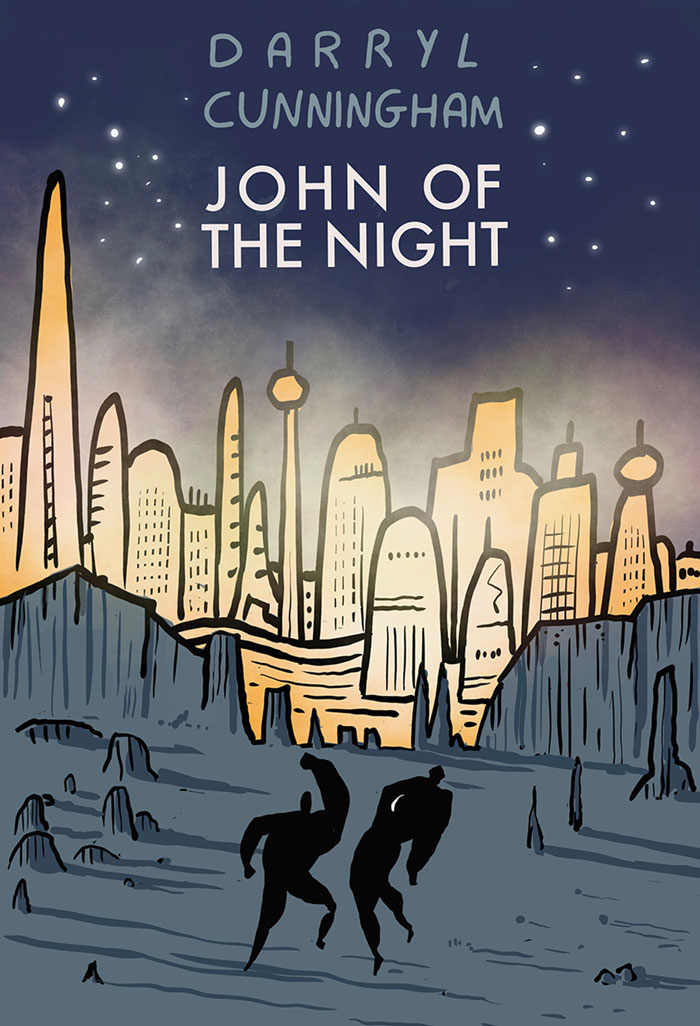
The result is John of the Night, his first fiction graphic novel, which is a wildly imaginative cosmic adventure. The story focuses on scientist John of the Night and his daughter Aysha, who are caught between a fanatical cult determined to “fix” the multiverse and Medea, Aysha’s witch-queen mother, who has plans of her own for her daughter. Inspired in part by the grand cosmic mythology of Jack Kirby, the book combines gods, multiverses, mythology and philosophical questions about good and evil with the much more grounded relationship between a father and daughter.
The new book arrives from Avery Hill Publishing on Sept. 2.
I spoke with Cunningham about the new book, the influence of Jack Kirby, creating Aysha and Medea, finding the balance between cosmic spectacle and emotional grounding, and what’s next for John of the Night.

Your previous books have largely been rooted in non-fiction — journalism, history and biography. What led you to creating a science fiction story like John of the Night?
I got tired of the constraints of non-fiction. I’ve always been an imaginative person, and I found that fact-based books didn’t allow me to run with my imagination the way I wanted to. I’ve had a lot of the ideas in John of the Night lying around in my head for years. Finally getting the chance to loosen myself from the restraints of non-fiction was exhilarating. That’s why John of the Night is such an explosion of creativity.
The book feels like it’s in conversation with Jack Kirby’s cosmic comics, but it also draws on mythology, religion and philosophy. Besides Jack Kirby, what were your biggest influences that shaped this story? And conversely, was there a particular Kirby story or era that influenced the story?
No particular Kirby era influenced me. Kirby routinely came back to the themes of Demi-gods and super humans throughout his career. People think about the Fourth World stories as his definitive take on the Gods mythology, but it was always there from early Marvel and Thor. I’m not a religious person, but the fantastical cosmic tales of mythology have always fascinated me, from when I first read the Greek myths as a child. As for the philosophy stuff. Thinking about what’s good and what’s evil is always relevant.
At the heart of all the cosmic spectacle is a father trying to save his daughter. Was it important to have that emotional relationship anchor a story with such enormous stakes?
It’s important that such a cosmic story has some recognisable elements that a reader can hang on to, otherwise it’s just a series of empty plot points. Humour helps a lot. John and Aysha came out of a series of drawings I did for fun. They kept showing up, so I began to wonder ‘who are these people? What is their relationship?’ And then one thing led to another in the way stories get built.
Medea is a fascinating character because she’s both a mother and an antagonist. How did you approach writing someone whose motivations are both deeply personal and morally unsettling?
In her own mind Medea thinks she’s doing the right thing. It’s interests me how people can justify the most extreme and abhorrent actions. We see this all the time in life. How can anyone hate others simply because of skin colour or because they don’t understand the complexities of gender? When you strip out imagination and empathy from a person, what’s left is pure selfishness. See Elon Musk for details.
And then, there’s my favorite character, Aysha, who brings both heart to the story and also a healthy dose of cynicism. I imagine she’s going to be everyone’s favorite character. Can you talk about her role in the story?
She is both the reader’s and my point of view within the story. She is someone who anyone would hope to be. She’s not superhuman, but is fearless and resourceful anyway. Nothing worries her. She’s devoted to her father. I instantly knew who she was from the first bits of dialogue she has on the early pages and never had to think about her motivation at all. She was fully formed from the beginning.
Your style here provides a stripped-down clarity to everything; even as big cosmic things are happening, it’s very easy to follow. How do you decide what details to include on the page and what to leave to the reader’s imagination?
I’m never going to be a Jack Kirby or Mike Mignola. So I draw to my strengths. I learned from years working on non-fiction books to present only the relevant facts and not to overcomplicate a panel or a page design. Usually this is because the information I’m giving to the reader is hugely complex. I don’t want the art to get in the way of the reader’s understanding. Straightforward artwork and a restrained colour pallet all help with this.
Do you see John of the Night as a self-contained story, or is this a universe you’d like to revisit in the future?
I’ve already begun the sequel to John of the Night, The Department of the Sun, which focuses on the further adventures of Aysha. It’s a kind of spy thriller set in a version of 1970s London. Plus I’m working on a related book to be drawn by another artist, which will feature a few of the John of the Night characters, including Aysha.