

Jordan Mechner has built a career around storytelling. Best known as the creator of Prince of Persia and The Last Express, Mechner has turned his attention to graphic novels in recent years, bringing the same cinematic sensibilities to projects ranging from Monte Cristo and Templar to his award-winning memoir Replay.
His latest graphic novel, Liberty, is currently being crowdfunded on Kickstarter by Magnetic Press. It tells the true story of a clandestine French operation that helped supply the American Revolution with desperately needed weapons, following playwright Pierre-Augustin Caron de Beaumarchais and American diplomat Silas Deane as they risk everything to support the fledgling United States from across the Atlantic. Illustrated by Étienne Le Roux, Loïc Chevallier and Elvire De Cock, Liberty shines a light on people whose contributions to history have largely been forgotten.
I spoke with Mechner about discovering the story behind Liberty, why he prefers history’s unsung heroes to its famous names, the challenge of balancing historical accuracy with compelling drama and more.
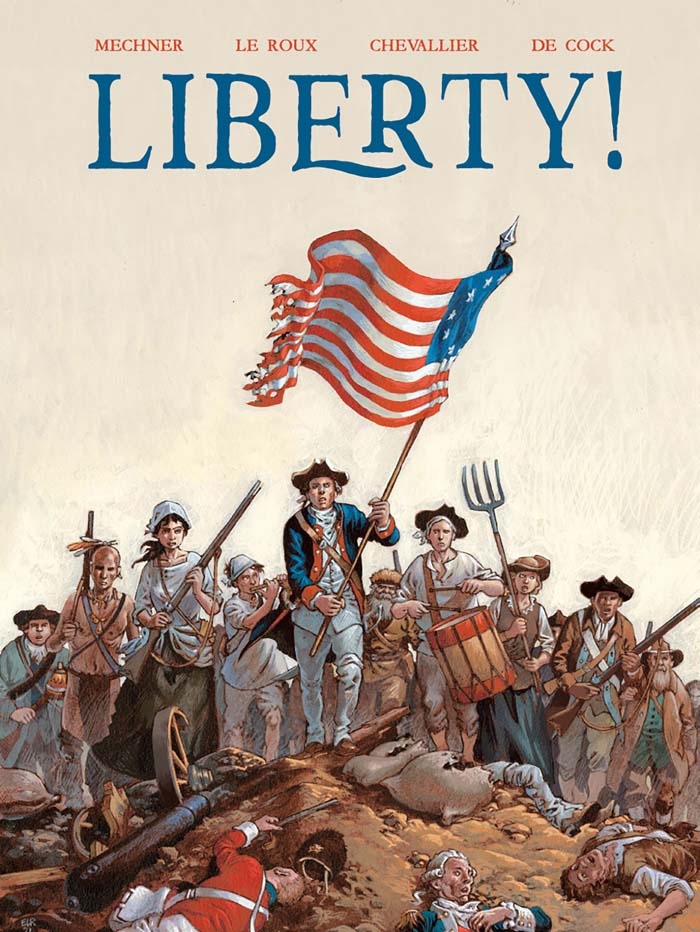
You said you knew you had to tell this story as soon as you learned about the clandestine French effort to arm the American Revolution. What was it about this hidden chapter of history that grabbed your imagination and convinced you it needed to become a graphic novel?
I was fascinated to discover not just that there was a secret pipeline to smuggle arms from France to the American rebels in 1776, run by civilians when the French king and official foreign policy forbid it– but that the man behind it was none other than Pierre Caron de Beaumarchais, the famous playwright who wrote my favorite Mozart opera! He was an early believer in freedom and democracy, in a world dominated by monarchies and tyrants–you can see it in his plays, and in a character like Figaro (the “Barber of Seville”) whose independent attitude foreshadows the French Revolution that was to come after the American one. The story is so gripping, with themes that are very present and relevant in today’s world– look at the current international efforts (and the factors limiting those efforts) to help arm Ukraine to defend itself against a Russian invasion, which seemed at first crushingly superior just as the British did in 1776.

One of the things that struck me about Liberty is that it focuses on people whose names aren’t nearly as familiar as Washington or Franklin. Are you consciously drawn to the stories that history tends to leave in the margins?
Definitely, part of the appeal and interest, and my way into the story, was that Beaumarchais and his American partner Silas Deane were unsung heroes. To this day, few Americans have heard of them or realize the importance of what they did for the revolution. As a reader, I’m actually more curious, interested and able to empathize with this kind of character. Biographical stories that focus on great names, like George Washington, Benjamin Franklin, or Napoleon, and make them the central characters, often don’t really come to life–it’s more fun to be surprised and discover things I didn’t know. I personally find it easier to grasp the real nature of what’s going on, in a war or upheaval or other major historical event, when I see it through the eyes of ordinary people–it connects more readily to my own experience and present day.

Historical fiction requires a balance between the facts and the demands of telling a good story. How did you decide where to stay faithful to the historical record and where to take creative liberties to build a story?
I have a very high bar for accuracy in historical fiction. I want to be entertained, moved and engaged, but if I find out that some important element of the story was made up or falsified, that spoils it for me–it’s cheating. Most Hollywood movies and TV series fudge the truth too much for my taste. I liked HBO’s John Adams; I was disappointed in the recent Benjamin Franklin series with Michael Douglas. (We won’t talk about Mel Gibson’s The Patriot.) My approach as a writer is to try to find the exciting story in the reality, rather than make up a new story. The dates and details of key battles and events in the American Revolution are carved in stone; that’s not the place to use dramatic license. In my research, I try to form an opinion or at least a plausible theory about what each character was like, why they did what they did–and then invent things that are consistent with that interpretation. This goes for side characters like Dr. Bancroft (the spy and traitor), as well as famous figures like Franklin and Lafayette. The third main hero of Liberty! is Silas Deane’s stepson, Sam Webb, a young American soldier who is with Washington at New York and Trenton. Samuel Blachley Webb was a real historical character–everything that happens to him in the book, including getting wounded in battle, captured by the British and released, matches the record; Deane really was his stepfather. Where I took dramatic license is in the emotional imprint of events; for example, having Sam and Deane quarrel before Deane leaves for France, so that Deane is haunted by the fear that Sam might be killed in battle before they have a chance to reconcile. Or a letter from Sam to Deane going undelivered when the ship carrying it is sunk by a British warship. Those kind of elements I felt free to invent, because they’re compatible with what is known about the characters and don’t contradict the historical record.

This is a story about the American Revolution, but it’s brought to life visually by French artists Étienne Le Roux and Loïc Chevallier. Did collaborating with them give you a different perspective on this period of history?
And Elvire De Cock, the amazing colorist! It was great to have both French and American perspectives on the team. The way the American Revolution is taught in school in France and America is quite different; but what really interested us was to go beyond the school version, and bring events to life in a way that would feel vivid and surprising. I’m familiar with New York and New Jersey because I grew up there, the artists have spent time in Paris and Bordeaux and French Atlantic ports, so all of us were able to bring personal knowledge that enriched the storytelling.

Your games, particularly Prince of Persia and The Last Express, are celebrated for their pacing and cinematic storytelling. When you’re writing comics, do you find yourself thinking about page turns and reveals the way you once thought about level design or interactive storytelling?
That’s a great comparison, and it’s absolutely true. The last panel on a right-hand page, just before the reader turns the page and reveals the next two-page spread, is very much like placing a trigger point to change the camera in a Prince of Persia level! Comics are an interactive medium, in the sense that readers decide how their eyes move over the page, how long to linger over each panel, when to turn the page (or turn back). Games and comics have this in common; whereas the rhythm and pacing of a movie’s storytelling is locked in the editing room, the pacing of a game or comics story is set by the player or reader. We’re not creating a fixed experience, so much as inviting the audience to participate in creating their own.

Looking back across your career, from creating video games to writing graphic novels, what do you think has remained constant about the kinds of stories you’re most interested in telling?
I seem to be drawn to stories that are grounded in real places and historical events. At one end of the spectrum, Liberty! and Replay (my autobiographical family memoir) are the most grounded. The Last Express, Monte Cristo, and Templar are somewhere in between, fictional stories set against a real timeline of events that actually happened. Karateka and Prince of Persia are more fantastical, but even there, part of the interest for me was to travel in my imagination to places and eras, medieval Japan and Persia, that had really existed. I love research, and finding or uncovering connections between things that aren’t normally thought of together. Now that I think of it, almost all the stories I tell are about ordinary people who go up against a tyrant–to save someone they love, to save their world or change it for the better. King George and Lord Sackville are somehow in the lineage of Nogaret, Akuma, and the Grand Vizier Jaffar. And the hero is always an underdog with no special powers. Unless you count being able to run on walls–but to me, that’s just basic agility, like Beaumarchais being able to turn a phrase.