
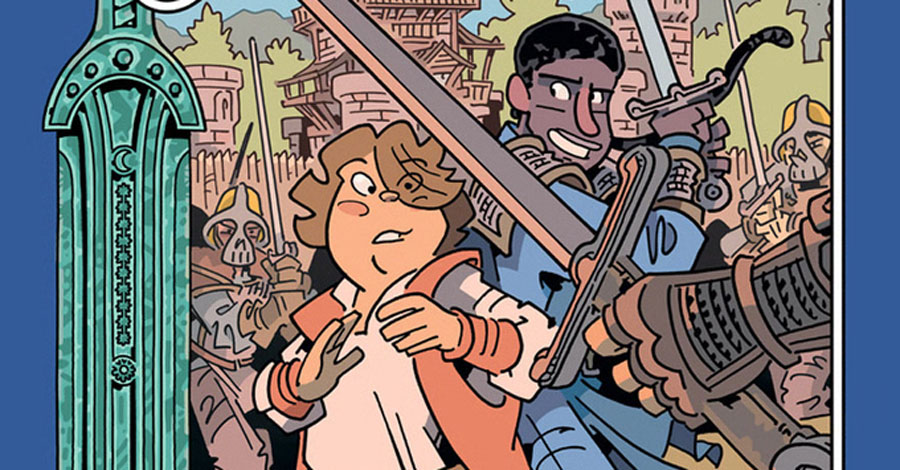
Chris Schweizer has spent years building a reputation as one of comics’ most engaging cartoonists, whether tackling historical adventures like his Crogan Adventures series, licensed comics like Mars Attacks! or creator-owned projects like 6 Sidekicks of Trigger Keaton. Now the former Savannah College of Art & Design professor is bringing Outlaw’s Apprentice, a series he launched on Webtoon earlier this year, to print through Kickstarter, giving readers a chance to experience the tale of a young outlaw-in-training in a handsome collected edition.
The campaign is already off to a strong start, but our conversation goes beyond the Kickstarter. Schweizer discusses the journey this idea has taken to get to this point, his approach to his craft when he’s both writing and drawing a project, how reaching the $40,000 mark in the campaign will benefit everyone in his home state of Kentucky and more.
Whether you’re backing Outlaw’s Apprentice, making comics yourself or simply curious about how great comics come together, Schweizer’s answers should be of interest. My thanks for his time.

I remember seeing character sheets you developed for this project online back in 2022. Can you talk about its origins and what it took to get from those initial sketches to what we see in the campaign?
There weren’t a lot of change to the designs or the general idea; the biggest shift was the point at which the story was going to begin. I was VERY tempted to jump right in with Otis and Erska on their travels, already outlaws, trying to stay ahead of the folks chasing them and taking on adventures.
I reckoned that the series’ prospective audience would want the action and adventure and the promise and delivery of the conceit of the stranger-comes-to-town subgenre right away, and that only AFTER that audience was invested in them would they care how or why they had been outlawed, that their “origin” would be played out in a dual narrative flashback in a later book. And so I did about 75, 100 pages of the first adventure that they have after finding themselves on the road, on the run.
Sometimes I’ll make decisions based on what I think “should” be, for analytical reasons, rather than going with my gut, and this was one of those, but my gut kept telling me that I should start at the beginning, at the point in which Otis makes a decision that sets everything else, irrevocably, in motion. And finally I figured, OK, I’ll start there, I’ll start at the beginning.
And I made the beginning, and it was the better part of 200 pages, and I intended to just tack it to the front of that first “real” adventure, and suddenly I was up to 350 pages, with another 200 needed to wrap that first adventure up. Which would be an awfully long book. Not insurmountable; I could do it, but what I COULDN’T do, despite my many attempts, was to make the beginning and the first adventure feel as though they were part of the same story.
Eventually I realized that even though I was awfully resistant to the idea, I should make that beginning section its own book. Rework it a bit so that it stands fully alone, but it had its own internal narrative to begin with.
I struggled, and still struggle, with the idea of having an “intro” book. I take some solace in Bone, which was incredibly formative for and influential to me; Outlaw’s Apprentice is no Bone, but I never had the slightest problem with its first volume, Out from Boneville, being no less setup-for-a-series than is Broken Blade for Outlaw’s Apprentice. I never resented Out from Boneville or felt like I was bilked. I enjoyed the heck out of it, and was invested and excited to read more. And so I’m hoping that other folks feel that way, too, even though what I envisioned as the premise for the series – outlaws help others both in order to stay ahead of the law and at the risk of failing to – isn’t really in play yet. They’re outlaws BECAUSE they helped others, but they’re largely concerned with getting themselves out of a jam for most of the book.
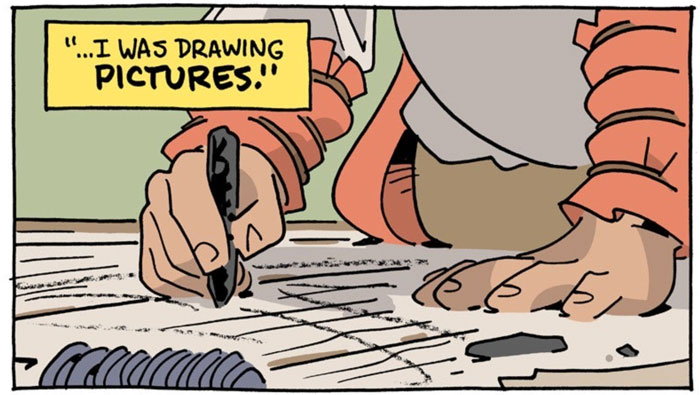
I believe in those early posts you mentioned wanting to do it as a series of graphic novels. When did you decide you wanted to share it on Webtoon first?
I always wanted its finished form to be a series of graphic novels, but I wanted to serialize it from the onset, too, and that dictated the format in which I wanted to work; the content was important to me, but I also was strongly motivated by a formal concern.
There are a lot of good scrolling comics (many on Webtoon and Tapas) that are collected into print, and there are a lot of good print comics that are serialized in scrolling format, but I have generally been very unsatisfied with how a comic created mostly for one works in the other, and felt strongly so at the beginning of ’22, which is when I decided on my solution. Directional reading, page layout, balloon placement… there are SO many factors that dictate how well a page works, how well it reads, and assembling panels on a page after the fact is a recipe for formal disaster, as is manipulating a larger print comic to adhere to the formal standards of a phone read; should one do a splash page, for instance, the line weight is suddenly dramatically finer than the line weight on the panels than precede or follow it, and the necessary scaling of any word balloons in the sized-down page result in a different composition, a different narrative effect. There’s a reason that Watterson bucked against the modularity of those shiftable, disposable intro-and-title panels in the Sundays; modularity and comics are not good bedfellows.
So my plan was to work small – specifically, to work for mass market paperback for print and phone screen for web, and to make pages that worked for both, their being of similar size, and that doing so would solve the format-translation issue that was vexing me as a reader.
I’m certainly not the only person to realize that the solution is to work smaller, and definitely not the first to enact it; Simon Roy’s Griz Grobus is a great example of this principle in action; Roy’s pages are small and readable in the scroll, and his print edition is likewise smaller than the standard fare.
But books were, and are, always the end goal. Books don’t necessarily have the permanence to which is frequently ascribed them – at least insofar as ready accessibility, they can go out of print, etc – but they’re not nearly as ephemeral as are digital platforms. Webtoons may be gone or ruined by equity in a year, so, too, might Patreon; books at least give you a decade, hopefully more.

Your work has always had a very distinctive cartooning style that’s incredibly expressive. How has your approach to storytelling evolved since the Crogan Adventures days?
The most notable change, probably, is that I’m trying to let the pages employ more tools than I’ve traditionally allowed myself: internal monologues, diagrams, things like that. I’m using, for lack of a better term, chibis, to serve as visual accent for thoughts, explanations, directions. I’m employing flashbacks. I’m using verb sound effects (I used to call it “arrowing” when teaching, from Homestar’s Teen Girl Squad comic).
I think about folks like Sam Raimi or Baz Lurhman and how they’ll use every tool at their disposal to elicit the audience response that they want, regardless of whether it’s elegant or classy. Fast zooms or a non-diegetic whipcrack sound effect. Fast motion. I can be snobby on the art front (can be? I’m almost always snobby on the art front) and I’ve been consciously trying to break away from that. Trying to be less concerned with small-d decorum, formal classiness. To recognize that it’s okay to do something that is not in itself an elegant or artful narrative tool if it is the most effective way to communicate information or a feeling to the audience. It doesn’t come naturally but it’s resulting in pages, moments, that I like a lot.
When you’re writing and drawing your own work, do you discover parts of the story while you’re illustrating, or is everything mapped out before you ever put pencil to paper?
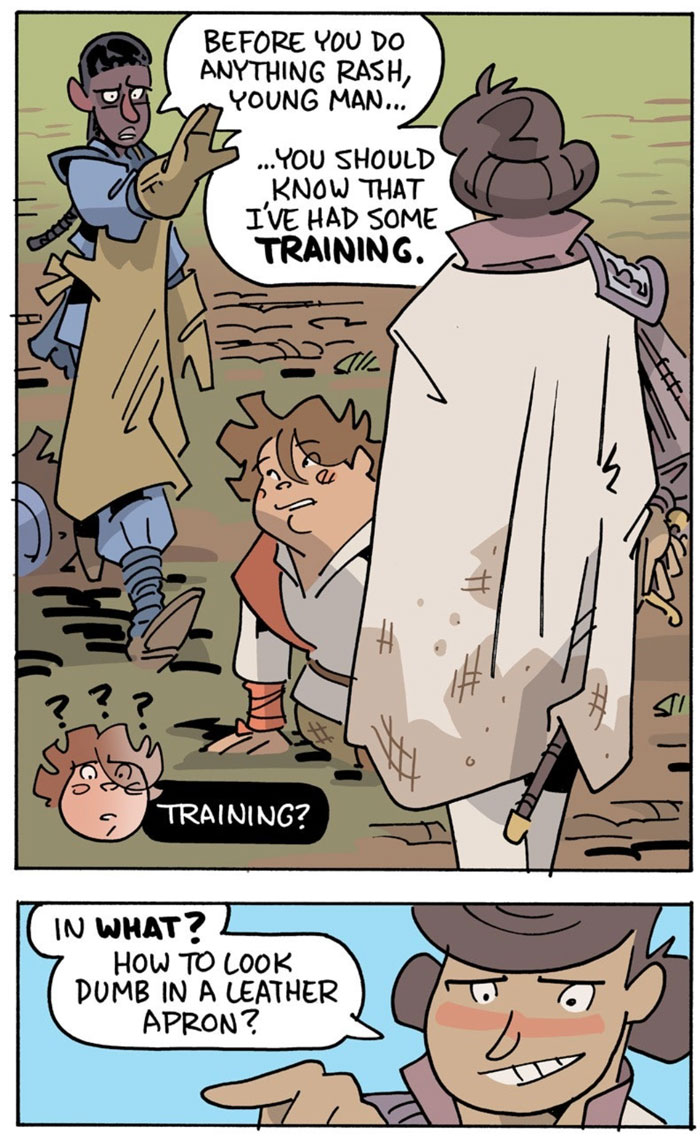
Almost everything is made up as I go along, at least insofar as the actual execution of a page goes. I know generally what is going to happen in a book, in a scene, but each page is a surprise: the dialogue, the body language, the movement, the attempted verisimilitude that I try to get in order to immerse the reader in a world that’s not entirely familiar, be it historical or fantastic. And frequently in those seat-of-the-pants moments those elements cause the immediate scene to veer into directions I wasn’t expecting. I might need space in a crowded panel for a word balloon, and the composition dictates that it must be in a certain place, and so, in order to make literal space for it, one of the characters stops walking to tie her shoe.
And BECAUSE that character stops to tie her shoe, the other characters have to stop, too. This gives another character time to better notice the surroundings and spot signs on a forthcoming ambush. Now, I might’ve intended an ambush, but not for a little while; tailoring the actions of the characters to the immediate formal needs of the page, or vice-versa, changes HOW those plot moments happen. Generally, they’ll still happen, but they happen differently than I might’ve expected, and so I try not to have as few expectations as I can. Letting each page dictate what happens on the next makes for a natural rhythm, makes everything feel consequential, and most of all, makes it so that the characters act in-character, not forced by outline to do something that feels contrary to how they’ve been behaving.
One of the things you mentioned, when talking about inspiration for the story, was how you were drawing from the history and culture of the Southeastern U.S., and more specifically greater Appalachia. Given that it’s a fantasy tale, I was hoping you could share more about how that influence shows up in the story.
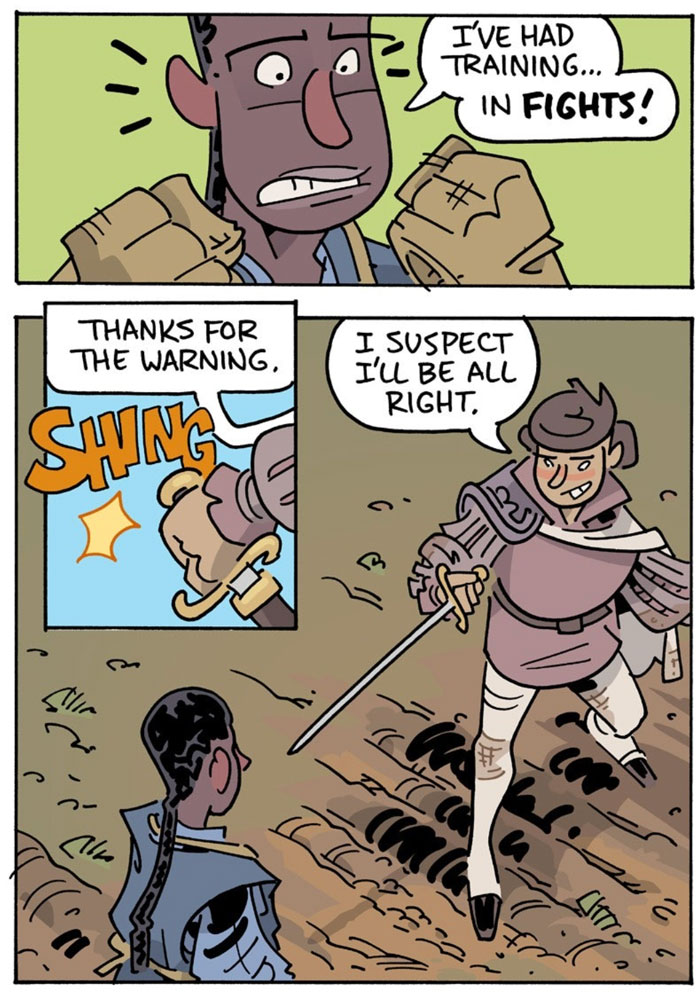
It manifests in a lot of ways: the language and syntax, for one. Rural folks tend towards a propensity for anthimeriating, probably because language is codified in centers of publishing and academia and may subsequently ignore the shorthand required of day-to-day rurality, be that cultural or vocational, so sidelining a grammatically correct clause in favor of a single word for brevity’s sake feels, to me, Appalachian, and it’s one of a number of tools I use, mostly without thinking too much about it, to give the language a regional flavor.
A lot of the social conditions that dictate the conflicts throughout the series find their origins in Appalachian history, both on the smaller scale – the central conflicts of the second and third books, for example, are inspired by regional labor uprisings and the conditions that led to them – and in the series as a whole, where some of the Benchmarks (the mini-nations/states that make up the country in which Outlaw’s Apprentice takes place) are subject to the same internal colonization that Appalachia has endured since its start, resulting both from and in the same combative and individualist nature of its people, and how that inherent individualism makes communal action a temporary occurrence whose gains can therefore only be temporary.
Also, the trappings. The food, the music… the geography, especially. As a kid I used the woods and cliffs and swamps and fields and creeks in which I played as stand-ins for the environments that I saw or read in stories; now I’m putting stories into those same woods and cliffs and swamps.
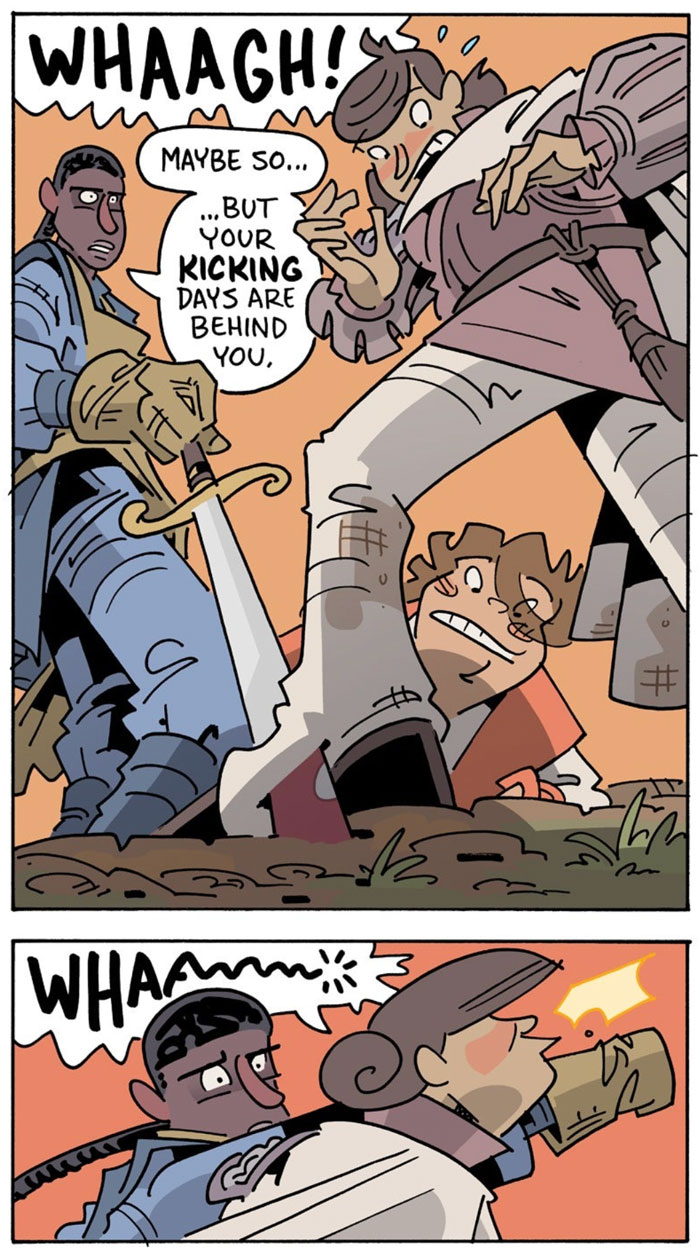
The campaign is already off to a strong start. Has the response matched what you were hoping for, or have there been any surprises?
It’s on track for what I was hoping; the middle two weeks of a campaign tend to doldrum, and as we’re coming into the third that’s proving true, so the last week will be a decider. I’m incredibly happy with how it’s done so far.
I’m a full-time cartoonist, and have been since 2013. This is the first comic since making that leap that I’ve done without a publishing partner, and the first book-length comic I’ve ever done without an advance, so we’ve been living lean for a little while in the hopes that the Kickstarter would make up the difference, and not only cover its publishing expenses but also pay the bills that have accumulated in the absence of a publishing contract.
It was a decision weighed carefully, to do this ourselves (ourselves meaning me and the family, who benefit or suffer together according to the fortunes of my work), and we knew that it would be risky, but, as you said, the campaign has had a very strong start. We’re not to the point of comfortable yet, but we’re getting close! I’m over the moon that so many folks have given the series a chance and opted to support it (and, deliberately or inadvertently, me). We’re doing a lot of stretch goals and I’m glad that they’ll get extras to demonstrate a sliver of my gratitude.
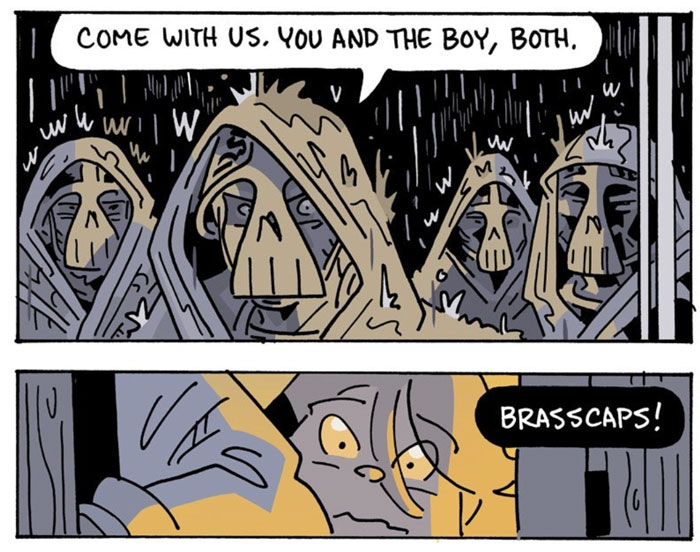
You’ve run crowdfunding campaigns before. Is there anything you’ve learned over the years that’s changed how you approach launching a Kickstarter?
Nuts and bolts stuff; the first campaign was for wooden Sherlock Holmes figures, and I didn’t realize that shipping, if collected during the campaign, was added to the campaign total, which dramatically affected what my actual “take” was and rendered moot the financial planning for the stretch goals. My second Kickstarter was the Dream of Swords art book, a couple of years ago; most of the lessons that I learned on the first were employed there, and it was a far easier undertaking.
It was doing Dream of Swords that gave me the confidence to do Outlaw’s Apprentice myself; I had very seriously considered turning the series into a single book, despite REALLY wanting to do it as a series, because that was what the publisher with whom I was in talks wanted. The idea of publishing it myself was, logistically, very daunting, but the experience of making Dream of Swords was such a good one – thanks in no small part to Minchao Mai at Tiger Printing, who is also shepherding the Outlaw books into their physical form – that I realized that I could do OA myself, and therefore as the series I wanted it to be, after all.
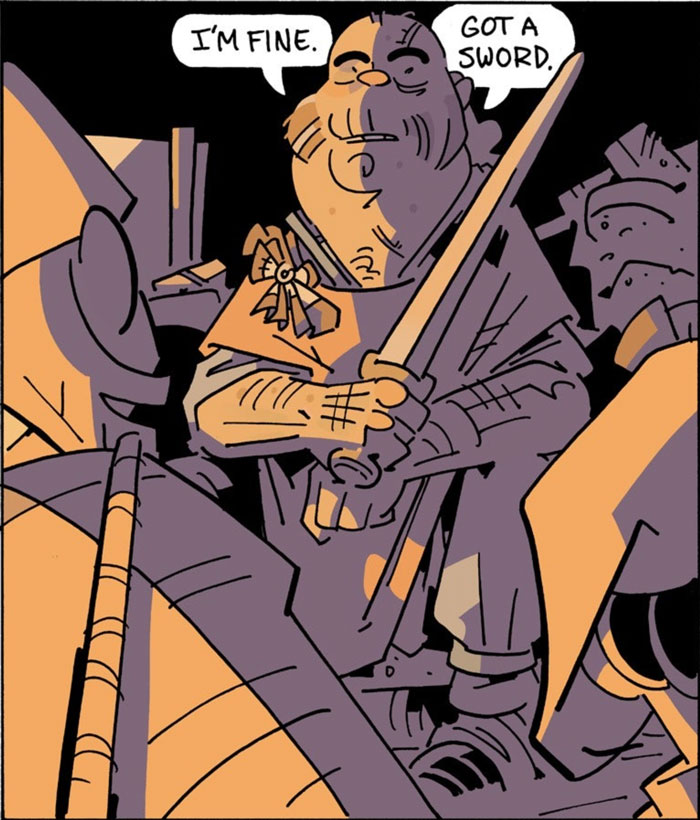
One of the most interesting stretch goals that I’ve seen probably in any Kickstarter is your $40,000 goal, and the donation of the book to libraries in Kentucky. Where did that idea come from, and why was that the milestone you wanted to build toward?
My wife and I (she far more than I) are both involved in our local library – I’ve served in a few different roles on the Friends of the Library board, as has she; she’s currently president of its Board of Trustees, I run the teens’ graphic novel club, my kid has been a perpetual staple at most every event they’ve put on for the past dozen years or so… it’s a big part of our life, and of the lives of a lot of folks in our community, but, like a lot of libraries, it really hurts for funding.
My own book may never impact a reader the way that the books I’ve found at the library have impacted me, but it’s my book, and I’m able to print more of them, and that puts me in a position to get it to a librarian regardless of whether they have the resources to order it. Graphic novels help drive circulation across all departments, so I see any additional title that ends up in the stacks as a win, all around. So once the campaign gets to the point where the publishing and campaign costs are covered, and we’re comfortably in the black from the months of its making, directing some of that largess towards Kentucky’s libraries felt like the best use of it.
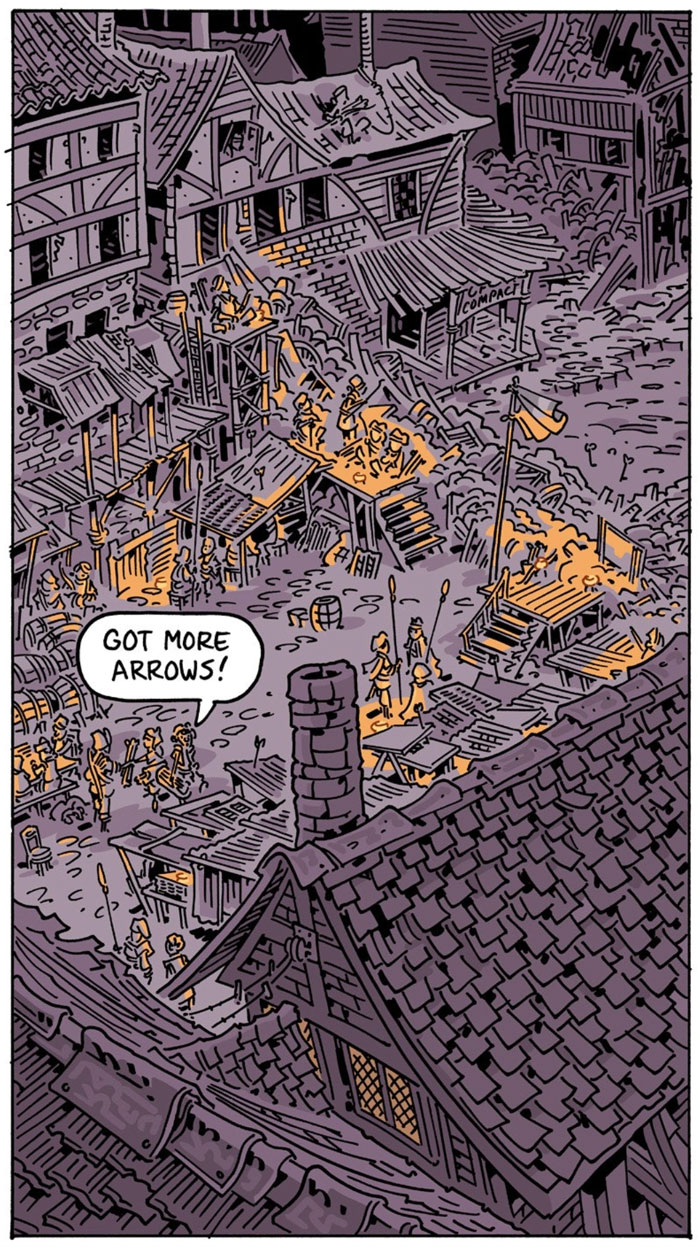
After the campaign, what’s next for Outlaw’s Apprentice? Do you have a definite ending in mind, or know how many books you’d like to eventually release?
I have a set number of books planned, but it’s a little bit flexible; should they prove popular enough to comfortably support their continued making, I could add a volume, and should response prove too squeaky to maintain with the degree of schedule dedication that I want to give it, I could maybe drop one book and work the ones on either side to account for the omission. I’d certainly rather add than subtract, but I also don’t want the series to feel bloated, or for its length to feel uninviting to new readers. I think that it has a fairly narrow length window to be at its best, and I intend to keep it within those confines.
For more information or to back the project, visit Kickstarter.